Showing posts with label BUILDINGS. Show all posts

Thursday, September 24, 2009

Dalian Stadium


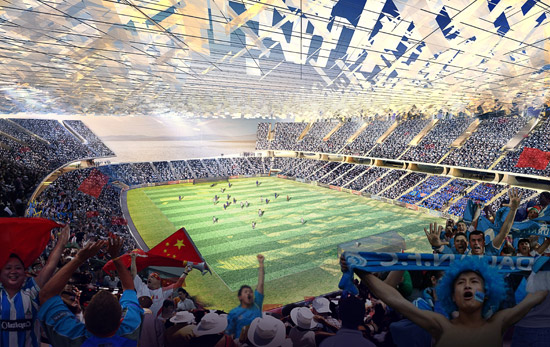
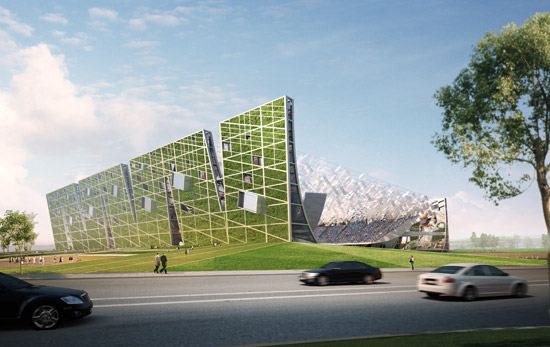
NBBJ has finalized their proposal for the new Dalian Shide Football Stadium in Dalian, China. The structure is designed with principles of organic architecture in mind, modeling itself after a garden by having only what is needed to thrive.

The design imagines if the ground were folded open to create two garden walls to contain the venue. This concept creates a strong visual impact and leaves both ends open to overlook the ocean and mountains nearby. The exterior of the walls are clad with living plants that naturally change colour throughout the year, while the inside features giant LED panels. A roof made from a flexible cable
system covers the stadium and is interwoven with fabric to shield the fans from the elements.

The design is an attempt to improve the in-stadium experience, rather than focus on the exterior form like many other modern stadiums. The stadium will have 40,000 seats and intends to set a new standard for sustainable stadium architecture.

http://www.nbbj.com


Friday, September 4, 2009

The Interlace Residential Complex, Singapore


the stacked buildings form a hexagonal arrangement
image courtesy of OMA


Designed by Ole Scheeren, partner of
OMA, The Interlace adopts a new residential typology which breaks away from the standard isolated, vertical apartment towers of Singapore.

The large-scale complex takes a more expansive and interconnected approach to living through communal spaces which are integrated into its lush surrounding greenbelt.

Thirty-one apartment blocks, each standing at six-storeys tall and identical in length,
are stacked in a hexagonal arrangement to form eight large open and permeable courtyards.

Developed by capitaland and hotel properties limited, the interlace covers 170,000m2 of gross floor area and will house 1,040 apartment units of varying sizes.

The design capitalizes on the generous size of the site which stretches between Singapore's Kent Ridge, Telok Blangah Hell and Mount Faber Parks, maximizing the presence of nature by introducing extensive roof gardens, landscaped sky terraces and cascading balconies.

The Interlace incorporates sustainability features through careful environmental analysis of sun, wind and micro-climate conditions on site and the integration of low-impact passive energy strategies.


an aerial rendering of the interlace's hexagonal formations
image courtesy of OMA


a detail of how the buildings are stacked upon one another
image courtesy of OMA

Thursday, August 20, 2009

NOAH (New Orleans Arcology Habitat)


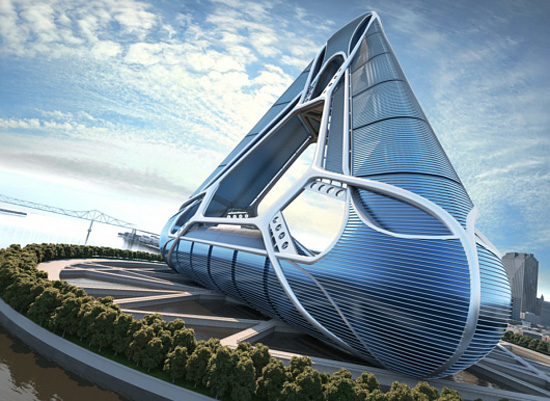
The New Orleans Arcology Habitat or 'NOAH' is a proposed urban arcology by architect E. Kevin Schopfer. In its built capacity the design will house 40,000 persons within a triangulated floating platform that includes: residential units, three hotels, three casinos, retail space, parking for 8,000 cars, cultural facilities, public works, a district school system and health care facility.

Following text from E. Kevin Schopfer:

NOAH is a proposed urban arcology (architecture and ecology) whose philosophic underpinnings rest in combining large scale sustainability concentrated urban structures, and in this case, a floating city. NOAH is an ideal demonstration project for all the right reasons. New Orleans is a city of both rich traditions and strategic importance. It is also a city with particular needs, both immediate and long term which must be addressed. These needs have been dramatized by the very nature of its location which has placed it in direct conflict with natural forces resulting in obvious impact. If global climate predictions are even remotely correct, New Orleans is already that future scenario today. Accordingly, New Orleans has an unprecedented opportunity to set new creative standards which address both current issues and also offer distinct prototypical guidance to the future needs of coastal cities.

Location/ Site Specific
In reviewing all the options and possible sites for NOAH, the most logical location is on the Mississippi riverfront and adjacent to the Central Business District. The location specifically will occupy an undeveloped parking area with an extended connection to the Audubon Aquarium of the Americas.


Why a floating city?
There are three major challenges which must be overcome to be of significant advantage to New Orleans. The first challenge is to overcome both the physical and psychological damages of recurring severe weather patterns. Though repopulation has begun, the need to provide a stabilized and safe environment is paramount to a long term recovery and economic well being of New Orleans. The second challenge is that New Orleans has too much water. The city has been built at and below sea levels which creates consistently high water table and makes it prone to flooding and storm surges. The third challenge is that New Orleans is built on soil condition which consists of thousands of feet of soft soil, silt and clay. These conditions make building large scale concentrated structures difficult. Believing that NOAH is a viable plan, our solution to overcome these challenges is to take advantage of these seemingly conflicting issues with the introduction of a floating urban platform.

Note: this proposal in no way suggests that ongoing water retention measures should be abandoned. Rather, a floating urban platform should be viewed as a complimentary venture.


Design brief / Exterior
The triangle is inherently the most rigid of all structural framing systems. The system is designed to dissipate gravity and severe wind loads through an all-steel applied (eko skeleton) exterior frame and conventional internal framing methodology. Second, the triangle is an 'open' frame configuration, dividing NOAH into three separate 'towers' converging at the top. The intent of this open system is to allow all severe weather /winds to in effect 'blow through' the structure in any direction with the minimum of massing interference. To further dissipate wind loads, the outer edges are curved and tilted. The 'tower' surfaces, both flat and curved, would be outfitted with secured sliding hurricane panels forming a uniform exterior protective barrier skin.

Sustainability / Ecology
NOAH is designed to expand the horizon of sustainability and will seek LEED certification. NOAH will eliminate the need for cars within the urban structure, and thus becomes a carbon neutral entity. Internal electric transport links, vertical and horizontal, create a pedestrian-friendly community. a wide range of passive and active provisions will be employed throughout the structure. Some of these elements are secured wind turbines, fresh water recovery and storage systems, passive glazing system, sky garden heating/cooling vents, grey water treatment, solar array banding panels, and river based water turbines.


You can read more details on the project here.

Olympic Rings Island, Sochi

via Designboom - Weblog on 8/19/09


Russian architecture studio
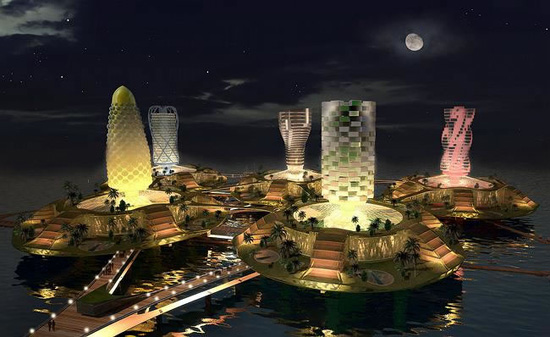
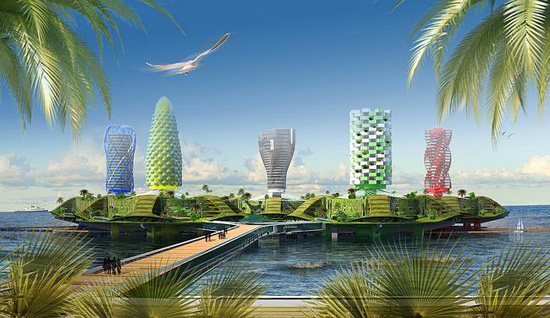
A.Asadov have designed a series of island complexes to be built in the city of Sochi ahead of the Winter Olympic Games there in 2014. Among the proposals is this one made up of five round 'islands' each with a tower in the middle. From a bird's-eye view they make the Olympic Rings Emblem.


The dark blue tower is Europe and the 'cold of scandinavian winter'. The black ring Africa 'is based on african sculpture'. The shape of the red tower uniting South and North America 'resembles brazilian carnivals, aztec sacrifice and indian conquest'. The tower of the yellow ring, Asia 'is like a chinese pagoda'. The last continent on the emblem, noted by green color, is Australia and 'it's nature'.


All the multicolored rings-plates of the five continents have common structure. The round foundation raised above the water on piles creates an atrium with public transport, hotel buildings are sited in different directions from there, and a tower crowns the construction � symbol of the continent.


'Such architectural complex would not only become a decoration and feature of Olympics in Sochi, but also one of the city�s symbols telling to the guests about the event of global significance.'

You can read more about A.Asadov's other proposals for Sochi
here.

Friday, August 14, 2009

Zaha Hadid Architects: Chaoyangmen SOHO III

via Designboom - Weblog on 8/13/09

chaoyangmen SOHO III by zaha hadid architects

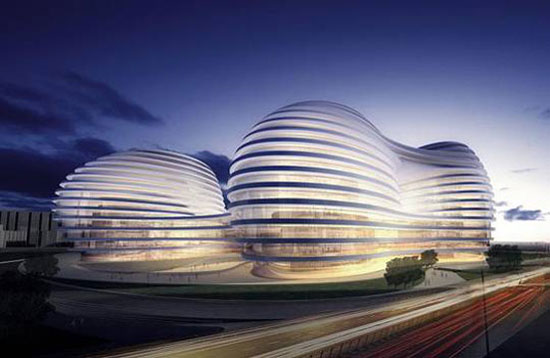
Zaha Hadid Architects recently unveiled plans of their project Chaoyangmen SOHO III,
located in the city center of Beijing. With the Headquarters Building of the Ministry
of Foreign Affairs on its east and Chaoyangmen SOHO I and II on its north, it is surrounded by different urban amenities including outdoor space, offices and residential spaces.
The total construction area of the project is 334,000 square meters, of which 166,000 and 86,000 square meters are designated for offices and retail uses respectively.

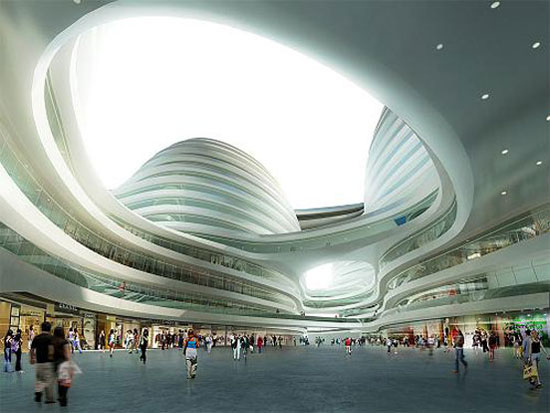
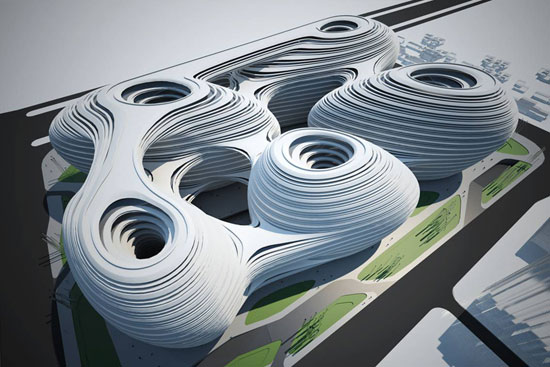
The project is designed based on the traditional chinese courtyard, an inner space within a building. Chaoyangmen SOHO III was conceived as a series of continuous and flowing volumes that coalesce, which fuse and pull apart as stretched bridges to create a world of continuous mutual adaptation.


chaoyangmen SOHO III - inner courtyard


chaoyangmen SOHO III aerial view rendering

Friday, August 7, 2009

How Not to Demolish a Building

via Gizmodo by Adam Frucci on 8/3/09

Most building demolitions are precisely planned and controlled. When they aren't, a factory in Cankiri, Turkey, does a barrel roll through the streets. Oops!

Saturday, July 25, 2009

OMA Ole Scheeren: Mahanakhon, Bangkok

via Designboom - Weblog on 7/23/09

mahanakhon by ole scheeren / OMA


ole scheeren of OMA has unveiled plans for maha nakhon, a 77 storey skyscraper
that will be the tallest building in bangkok.

the complex at 150,000 square meters (approximately 1,6 million square feet) is a series
of components that comprise mahanakhon square, a landscaped outdoor public plaza
intended as a new public destination within the city; maha nakhon terraces, 10,000 square
meters (nearly 110,000 square feet) of luxury retail space with lush gardens and terraces
spread over multiple levels for restaurants, cafes and a 24 hour marketplace. also included
is the ritz-carlton residences, bangkok with 200 highly-customized single-level and duplex homes,
each offering the atmosphere of a skybox penthouse and the bangkok edition, a signature boutique
hotel with 150 hotel rooms, a collaboration between marriott international and renowned
hotelier ian schrager; and a multi-level roof-top sky bar and restaurant.


mahanakhon

with its distinctive sculptural appearance, mahanakhon has been carefully carved
to introduce a three dimensional ribbon of architectural �pixels� that circle the tower�s
full height, as if excavating portions of the elegant glass curtain wall to reveal
the inner life of the building metaphorically and actually an architecture that encloses
and protects its inhabitants while revealing the inner life of their city.


mahanakhon - top view


mahanakhon - base

the 7-storey area of the tower�s base houses luxury retail and dining areas. here
mahanakhon�s architecture is articulated to evoke the shifting protrusions of a mountain
landscape. the building also features an adjacent freestanding 7-storey building known
as the cube, with multi-level indoor/outdoor terraces offering a network of social spaces
with an extensive and carefully selected mix of dining and leisure facilities that serve
the general public will have acces to via a direct above-ground pedestrian link to
the main cbd skytrain station and plaza-level access.

the building is due to be completed by 2012.


mahanakhon

Tuesday, June 30, 2009

Paul Raff Studio: Cascade House

via Designboom - Weblog on 6/29/09

photo courtesy of paul raff studio
credit ben rahn

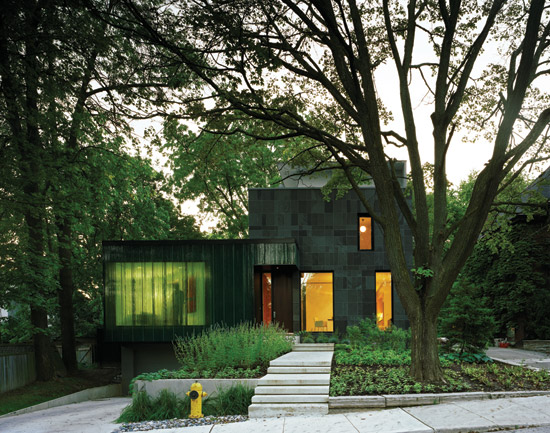
paul raff studio create a sustainable contemporary home in toronto�s conservative forest hill neighbourhood.
the family home is composed of a series of volumes stacked on top of one another. the home is clad in
muted black slate and covered in large expansive windows to let the natural light inside. the home is two
and half soterys and is designed in an l-formation around an outdoor swimming pool. the orientation of the
home and its windows was particularly set to maximize sun exposure. the heavy use of glass is best
exemplified by the 13-foot front window made from 475 vertically stacked sheets of heavy, jagged-cut
glass. the center of the home is accented with a black slate wall that is perforated with windows, running
through each floor. the whole home covers 325m square.

http://www.paulraffstudio.com

photo courtesy of paul raff studio
credit ben rahn


photos courtesy of paul raff studio
credit steve tsai


photo courtesy of paul raff studio
credit ben rahn


photo courtesy of paul raff studio


photo courtesy of paul raff studio

Wednesday, June 24, 2009

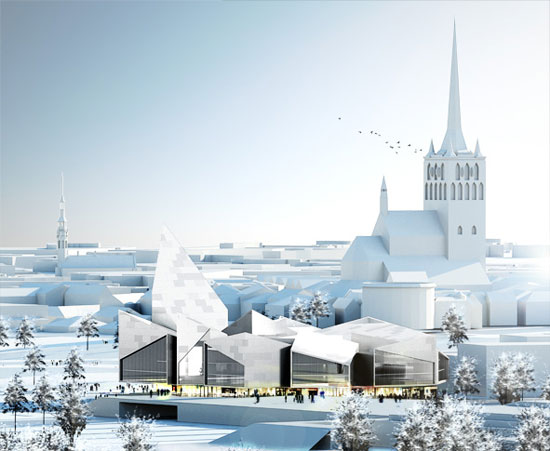
BIG Architects: New Town Hall of Tallin, Estonia

via Designboom - Weblog on 6/24/09
tallin town hall by BIG architects
image courtesy BIG architects


BIG architects have won the international competition to design the new town hall
of tallin, estonia

the various public departments form a porous canopy above the public service market place
allowing both daylight and view to permeate the structure.

the city council, the heart of the democratic process, is located in the town hall tower visible
from the park, the plaza and the podium of the linnen hall. the roof of the tower is tilted forming
a slender spire. inside the city council greeting hall is accessed via the grand stair or elevators
directly from the market place, or from the city offices around it. above the greeting hall, the city
council is located in a generous space illuminated though a large window facing the city.
a balcony for press and visitors flanks the space on the level above. the sloping ceiling of the tower
is finished in a large reflective material. the mirror ceiling transforms the tower into a huge
democratic periscope allowing literal transparency between politicians and public. in ancient times
the town hall would have a vaulted ceiling decorated with a sky or frescos of the land and territories
under the ruler�s government. in the new town hall of tallinn the ceiling will be a real (reflected) overview
of the city both old and new. the circular formation of council members will be reflected in the tilted ceiling.
from a distance the silhouette of the town hall tower enters the family of tallinn�s
historical spires including those of the niguliste museum-concert hall, toomkirik, kaarli kirik,
p�havaimu kirik, st. olav church and the current town hall.


tallin town hall
image courtesy BIG architects


tallin town hall
image courtesy BIG architects

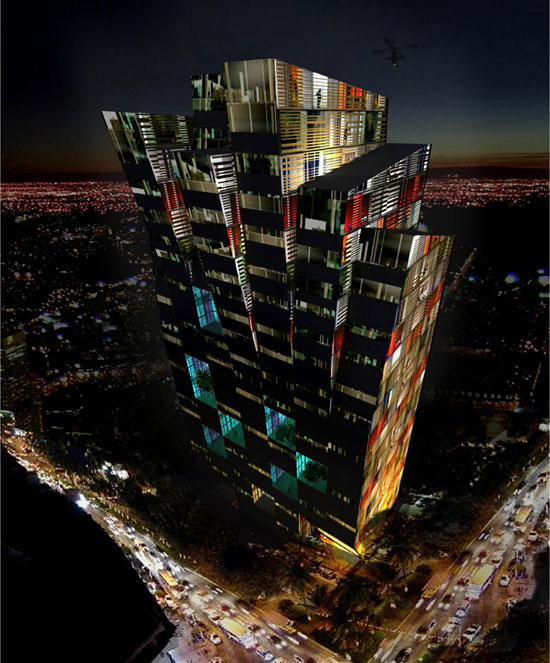
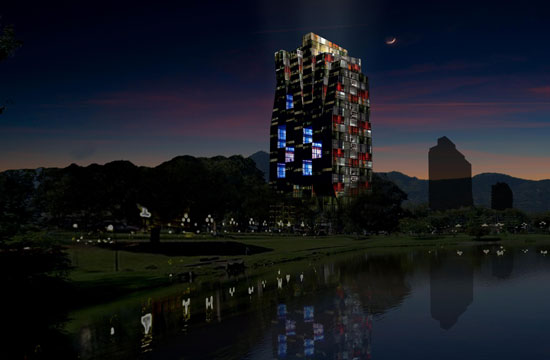
Moho Architects: Mixed Use Tower in San Jose de Costa Rica

via Designboom - Weblog on 6/22/09

mixed used tower, san jose costa rica
image courtesy moho architects


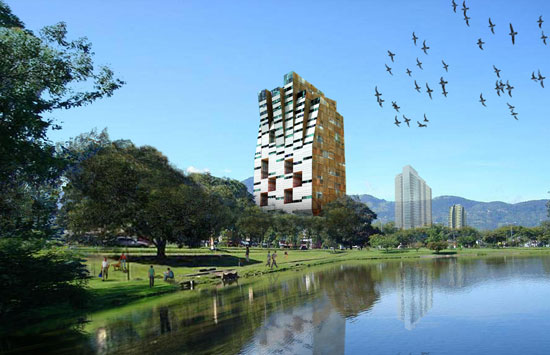
rising above the skyline of san jose in costa rica, this mixed use tower by spanish firm
moho architects will be a new landmark, providing crucial amenities for the city, sheltered
from the local climate. the concept is driven by a progressive environmental strategy that
is expected to establish new benchmarks for the region.

the building offers an ideal model of sustainable urban living by reducing reliance on
transport and balancing energy consumption between its mixed-use program of day
and night time activities. program include mixed commercial and retail spaces together
with a business centre, offices, conference rooms, hotel floors and casino. the tower rises
25 floors consisting of a viewing platform and restaurant providing panoramic views
over the city.

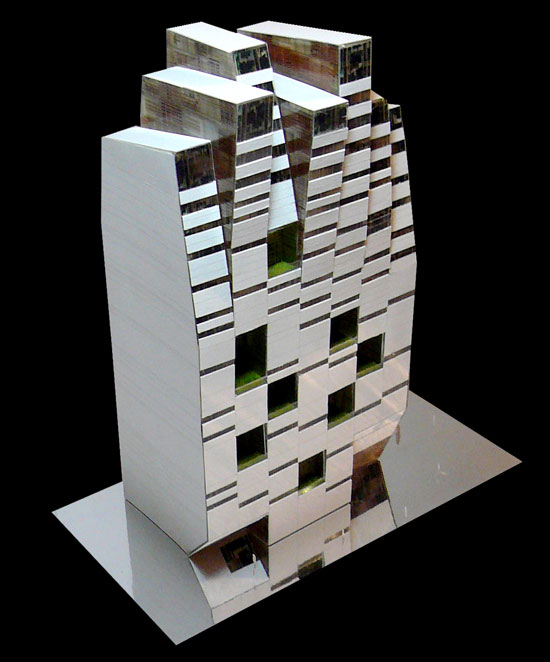
the tower splits and creases independently as it rises into the sky. this 'head split' configuration,
permits natural lighting, while sky courts filled with vegetation punctuate at intervals the tower
and mitigate the hot climate.

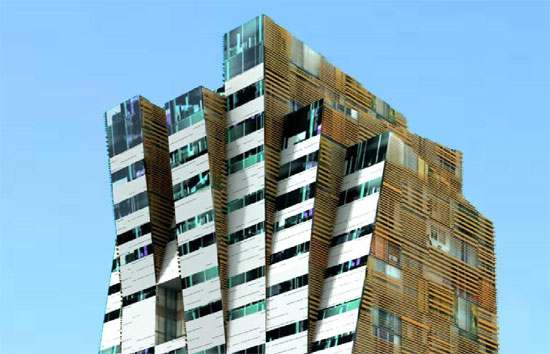
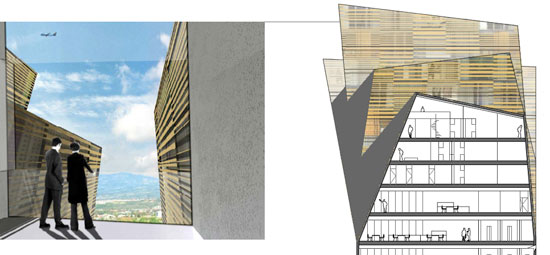
the development will take advantage of a number of sustainable energy strategies and key
to the energy performance of the building are its wooden brise-soleil facades, designed to
filter solar gain and to encourage daylight to permeate the complex. the tower is intended to
be a paradigm for passive environmental control, providing an alternative to the more conventional models
of sealed and air-conditioned glass stumps. the layered facade cuts air-conditioning load
and the plan encourages daylight, reducing the need for artificial lighting.

the project is currently in the schematic design phase and is expected to be completed in 2012.


mixed used tower
image courtesy moho architects


mixed used tower
image courtesy moho architects


mixed used tower
image courtesy moho architects


mixed used tower - model
image courtesy moho architects


mixed used tower - sections
image courtesy moho architects


mixed used tower - sections
image courtesy moho architects

Wednesday, June 17, 2009

3XN: Danish Pavillion proposal for Shanghai 2010

via Designboom - Weblog on 6/17/09

danish pavillion by 3XN architects
image courtesy 3XN architects


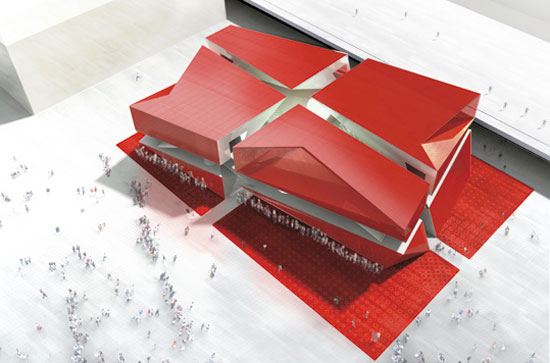
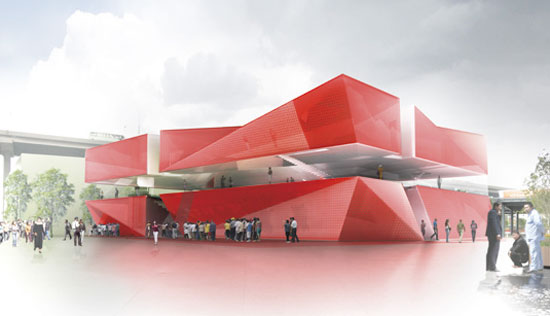
3XN architects proposal for the danish pavilion at the shanghai expo 2010 is
easily recognisable from a distance. with its two colours white and red and simple
rectangles, the building says denmark more clearly than any other image or symbol.

the pavilion is in the shape of the danish flag on all sides � also top and bottom.
the four red rectangular fields, thus, form eight blocks and the white in the flag can
be opened in both directions to form an inner square or urban space at the heart of
the building. the total volume is tilted slightly to one side, and emphasised in strategic
places, thus creating an entrance and an exit that provides shelter from the rain
and shade on sunny days.


danish pavillion
image courtesy 3XN architects


danish pavillion
image courtesy 3XN architects


danish pavillion
image courtesy 3XN architects


danish pavillion interior
image courtesy 3XN architects


danish pavillion interior
image courtesy 3XN architects


danish pavillion interior
image courtesy 3XN architects

Sunday, June 14, 2009

Spain's Selgascano architects built themselves an awesome Office In The Woods

via DVICE by Kevin Hall on 6/12/09
Selgas-Cano-Office-2381.jpg

One of the perks of being an architecture firm such as Spain's Selgascano is that you get to design yourself an awesome place to work. Check out Selgascano's "office in the woods," designed by the company's Jose Selgas and Lucia Cano. It's one long, tunnel-like office covered by a curved transparent acrylic window that's 20 millimeters thick and lets in plenty of natural light. The 110-millimeter-thick opaque wall is made from layers of insulated fiberglass and polyester, and shades the office.

To keep things inside cool, one of the ends of the office is attached to a pulley system and the slab can be raised or lowered, letting in some fresh air. Explore more of the office in the woods below, thanks to the gorgeous photography of Iwan Baan.

Selgas-Cano-Office-2507.jpg

Selgas-Cano-Office-2881.jpg

Selgas-Cano-Office-2339.jpg

Selgas-Cano-Office-2939.jpg

Super Sport Car Evolution