Showing posts with label SPACE. Show all posts

Wednesday, September 2, 2009

Japan to Spend $21,000,000,000 on a Power Plant in Space

via Gizmodo by Adam Frucci

Holy shit, Japan is getting prepped to drop $21 billion on a solar power station in space, one that will beam enough energy back to Earth to power 294,000 homes. With no cables.

The whole deal is being put together by Mitsubishi Electric Corp. and industrial design company IGI Corp. The plan involves a gigantic solar panel floating around in space, soaking up a gigawatt of energy and beaming it to Earth without the use of cables. And they hope to have it ready to rock within four years.

Friday, August 14, 2009

A Beach On Mars

via Gizmodo by Jesus Diaz on 8/13/09


The Mars Reconnaissance Orbiter's HiRISE�High Resolution Imaging Science Experiment�camera has captured one of the most beautiful photographs of Mars to date: An oblique view�at 22 degrees east of straight down�of the Victoria Crater, in the Meridiani Planum region.

According to NASA, this unique angle will give scientist a great opportunity to study the geological layers in this area. It looks like a dried lake to me�of course is not�but that's just my ignorant untrained eye making things up.

Wednesday, August 12, 2009

The Most Amazing Photo of the Universe, Now In 3D

via Gizmodo by Jesus Diaz on 8/11/09

Showing 10,000 galaxies, the overwhelming Hubble Ultra Deep Field is the most amazing, most humbling image in history, demonstrating how tiny and precious we are. This video explains how it was taken, and shows it in three dimensions.

Tuesday, August 11, 2009

What Is This?

via Gizmodo by Jack Loftus on 8/9/09

Ready for some mystery? The answer is... we don't know!

It's true. We (being astronomers and people far smarter than I) really don't know. But we do know where this mysterious event took place: One billion kilometers away, in Saturn's F ring.

The pic was snapped by a school bus sized gadget we call Cassini. It's been orbiting Saturn since 2004, and the wealth of data, photos and knowledge beamed back to us in that timeframe is nothing short of amazing.

But this latest snapshot is an enigma. Something punched through the F ring, violently spewing a plume of dust, ice and rock out into the nothingness�but what?

Even more mysterious is the bright spot left in the object's wake. Icy crystals laid bare for the Sun's rays? A new material? A cosmic mooning from some alien prankster? Possibly, but whatever it is, it's yet another reminder of how violent and unexpected space can be.

Friday, July 31, 2009

Skylon spaceplane concept

via DVICE by Addy Dugdale on 7/30/09

Somewhat reminiscent of one of Professor Calculus's creations for cub reporter Tintin, the Skylon is what is known as a reusable launch vehicle for unpiloted space shenanigans. In short, it's a space plane. The creation of Reaction Engines Limited, a British outfit based at the Culham Science Center in Oxfordshire, the Skylon will be able to take off from and land at normal airport runways in order to deliver its payload of up to 13 tons in orbit.

All of this is down to Skylon's Sabre propulsion system, which is part jet engine, part rocket engine. The thrust is created by burning hydrogen and oxygen � a tricky concept, because air in the lower atmosphere can reach temperatures of 1000 degrees Centigrade. In order to cool the air before compressing and burning it, Reaction Engines have created a heat exchanger pre-cooler, which consists of ultra-fine piping that drops the temperature of the hot intake gases to minus 130 degrees Centigrade in just one hundredth of a second.

Whilst perhaps not yet as tangible as Richard Branson's White Knight Two, Skylon's technology is, you've got to admit, pretty amazing. And just look at the scale of the thing � it's immense! � in the gallery below. What does it remind you of?

*Cheaper than most space travel, that is.

Wednesday, July 29, 2009

Ion Engines Could Get Us to Mars in 39 Days

via Gizmodo by Adam Frucci on 7/27/09

The VASIMR ion engine could - if powered by an onboard nuclear reactor - take astronauts to Mars in just 39 days (Illustration: Ad Astra Rocket Company)

With current rocket technology, it would take six months for us to travel to Mars. But with nuclear-powered ion engine technology? Well, that'd take more like six weeks.

Ion engines aren't strong enough to lift a rocket out of orbit, but once a ship is in space it would make the trip to Mars a hell of a lot faster.

Ion engines, on the other hand, accelerate electrically charged atoms, or ions, through an electric field, thereby pushing the spacecraft in the opposite direction. They provide much less thrust at a given moment than do chemical rockets, which means they can't break free of the Earth's gravity on their own.

But once in space, they can give a continuous push for years, like a steady breeze at the back of a sailboat, accelerating gradually until they're moving faster than chemical rockets.

If connected to an onboard nuclear reactor, an ion engine could propel a craft to mars in a mere 39 days, which would make the whole trip worthwhile. Of course, first they need to figure out how to put a nuclear reactor on a spaceship and also build an appropriately badass ion engine. But once they do that, we're golden.

Tuesday, July 21, 2009

Idiots Want to Draw Ads On the Moon

via Gizmodo by Jesus Diaz on 7/20/09

A company wants to "license a technology" to draw advertisements on the Moon's surface, which according to them could be watched from Earth. If nobody shuts them down, I'll be there at the launch. With my land-to-air rocket launcher ready.

I thought this was a joke, but apparently this deranged people are serious enough about it to put out a press release and a 3D animation.

Robots to Advertise on the Moon

WEST VALLEY CITY, Utah, July 20 /PRNewswire/ � It's one giant leap for robot-kind. New Shadow Shaping technology creates images on the Moon that can be seen from Earth. Robots are used to create several small ridges in the lunar dust over large areas that capture shadows and shape them to form logos, domains names, memorials or even portraits. Talk about the Man in the Moon! You can even carve your initials in a heart to impress your sweetheart.

The advertising potential is mind-boggling. Never in history have companies been able to penetrate every market on Earth, reach every person on the planet, and touch them at an emotional level only possible with the beauty of the Moon on a starlit night. Twelve billion eyeballs looking at your logo in the sky for several days every month. And since there is no atmosphere on the Moon, the images last for thousands of years.

"Finally dependency on government to travel beyond Earth is over," says inventor David Kent Jones. "This new commercial incentive will turbo charge space technology development. Shadows are just the beginning; eventually robots will be planting crops on other planets."

Beginning July 20, 2009, the fortieth anniversary of man's first step on the Moon, exclusive licensing for this patent pending technology is publicly available. Moon Publicity is accepting bids from accredited investors and companies for 44 lunar regions until October 20, 2009. You could license moon-imaging technology potentially worth a fortune in advertising value for about the cost of an SUV. Minimum bids start as low as $46,000. For more information visit MoonPublicity.com.

Of course, anybody can do this. The whole things sounds like a scheme to get easy money, yes. I have a hard time thinking someone may take them seriously, but it's a matter of time before some idiots actually manage to pull it off.

Saturday, June 27, 2009

Scenes from the ISS

via DVICE by Kevin Hall on 6/26/09
'Scenes from the ISS' shows the world from an astronaut's eyes

You may have seen the shots of Russia's Sarychev volcano eruption NASA postedearlier this week. Well, the folks over at the Boston Globe's Big Picture went through the archives of other photos taken from the ISS, and have dug up some gems.

Some of our favorites are down below. The first is probably the wildest: what looks like an instrumentation panel or a blueprint is actually a photo of roads and circular fields in Egypt. There are also breathtaking views of volcanoes, islands, rivers and cities. What better view can you get of this planet of ours than from the International Space Station?

Sunday, June 7, 2009

So Close to the Moon You Can Almost Touch It

via�Gizmodo�by Jesus Diaz on 6/5/09

Selene� Japan Aerospace Exploration Agency's spacecraft�mapping and filming the moon in High Definition�for the first time�keeps returning crystal-clear videos of the Moon surface. And the video will keep getting closer and closer, until it crashes.

The video next to these lines shows Antoniadi from approximately 13 miles (21 km). The large impact crater�located on the southern hemisphere, on the far side of the Moon�has an irregular edge, and it's one of the few craters in our satellite that has a second inner ring. Antoniadi's lowest point�measured by Selene's laser altimeter-is 5.5 miles deep.

The video below was taken from the perilune, the closest point to the Moon in Selene's trajectory: Just 6.8 miles high.

According to JAXA, the impact will take place on 18:30, June 10, 2009 (GMT) at E80 S63, on the near side of the moon, close to its south pole.

Until then, Kaguya�as it's called in Japanese�will keep recording high definition video at low altitude and doing whatever cool Moon probes do when they are not being watched, probably sing Sinatra songs. [JAXA YouTube Channel�and�JAXA]

Wednesday, May 20, 2009

Time-Lapse Photography Captures Galactic Core of the Milky Way

via�Gizmodo�by Dan Nosowitz on 5/18/09

This gorgeous video is a compilation of shots taken with a Canon EOS-5D every 20 seconds over about nine hours at a star party in Fort Davis, Texas. It's a humbling sight.

Galactic Center of Milky Way Rises over Texas Star Party�from�William Castleman�on�Vimeo.

Some specifics: The Canon was equipped with a fisheye lens (an EF 15mm f/2.8 lens) and powered with an external battery to capture all that goodness. The more interesting part is the replacement anti-alias filter the photographer, William Castleman, used: The Canon's stock AA filter blocks out certain red wavelengths to achieve a "more desirable" skin tone, but if it's replaced with a filter that lets those wavelengths in, you've got yourself a camera capable of shooting a galaxy, as seen here, even if we can't see it with the naked eye. Really, really cool stuff. [Vimeo�via�Crunchgear]


Friday, May 15, 2009

Stunning Images of Atlantis, Hubble in the Face of the Sun

via Gizmodo by John Herrman on 5/15/09

It's difficult to imagine a more epic scene, but this photo has modest origins: amateur Astronomer Thierry Legault shot it with nothing but his own telescope, a solar prism and a Canon 5D Mk II.

Shot just after launch, the image shows the faraway scene as viewed through a Takahashi TOA-130 refractor telescope (focal length 2200mm) and a Baader solar prism, which gives the Sun its muted look. Strapped to the back of the telescope, the 5D was set to ISO 100 and a 1/8000 shutter speed, the camera's extreme low and high settings, respectively [Edit: woops, the Mk II actually does ISO 50]. Legault used the free online Celestial Observer tool to calculate the best time to shoot from his location.Meanwhile, that little silhouette is the scene of an incredibly complex and dangerousHubble rescue mission, which will repair a number of the craft's instruments, install a new camera and ensure that NASA's flagship orbital telescope keeps sending us amazing images for years to come.

Check out the unbelievable uncropped photos at Legault's site. �Note: It should be obvious, but don't try anything like this unless you know exactly what you're doing. Your eyes, they will burn. [Thierry Legault via Daily Mail]

Wednesday, May 13, 2009

X Prize Team to Send Swarm of Spiders to the Moon

via�Gizmodo�by Jesus Diaz on 5/13/09

Team Italia, one of the organizations competing to land a robot on the moon by 2012, is planning to launch a swarm of spiders designed to move fast and collect data through sensors and cameras.

Team Italia still has a long way to go to win the�Google X Prize�which will award to $20 million to the first team to land a robot, have it move half a kilometer, and send high definition images back to Earth by 2012. They are now in the design phase, which looking at the image, apparently revolves around the idea of freaking out any astronaut coming later in an Orion spacecraft. [Space.com]

Robotul spatial Spirit a ramas blocat �n solul martian

via�Antena3 - Stiinta�on 5/12/09
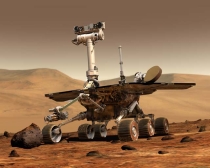
Robotul Spirit

Rotile robotului Spirit, care exploreaza de mai mult de cinci ani planeta Marte, au ramas blocate �n solul martian de c�teva saptam�ni. O echipa a Jet Propulsion Laboratory (JPL), apartin�nd NASA, a identificat problema si urmeaza efectueze o serie de teste cu ajutorul unui prototip de test, pe Pam�nt. "Spirit este �ntr-o situatie foarte dificila", a spus managerul de proiect al JPL, John Callas.

Inginerii si oamenii de stiinta sunt �ngrijorati, deoarece sasiul robotului ar putea atinge stratul st�ncos de sub nisip, ceea ce ar putea sa complice eforturile de a-l salva. Ei au �ncetat pentru moment sa mai trimita comenzi robotului si spun ca ar putea sa dureze mai multe saptam�ni p�na c�nd acesta va fi repus �n functiune, precizeaza Associated Press.

Spirit, alaturi de "geamanul sau" Opportunity, au aterizat �n puncte opuse ale planetei Marte �n 2004 si si-au depasit cu mult cele trei luni prevazute initial de misiune. Spirit este dotat cu sase roti, dintre care doar cinci mai sunt functionale, deoarece roata din fata dreapta s-a defectat �n urma cu trei ani.

�n ultima vreme, Spirit a �nceput sa �si arate v�rsta. Luna trecuta a avut c�teva probleme tehnice care includ pierderi de memorie si lipsa de raspuns la comenzi. Desi a fost reparat la momentul respectiv, inginerii nu au reusit �nca sa descopere ce anume a provocat defectiunile.

Friday, May 8, 2009

Neutron Star Crusts Are 10 Billion Times Stronger Than Steel

via�Gizmodo�by Dan Nosowitz on 5/6/09

A teaspoon of this stuff would weigh 100 million tons, and the only thing more dense is a black hole. Space is weird.

Scientists at the University of Indiana have shown the incredible density and molecular strength of�neutron stars, which as all you amateur astronomers know is the leftover from a gravitational collapse of a star during a supernova. The research was started out of concern that the intense gravitational pull of these things could cause ripples in space-time, but could lead to new understanding of star quakes or magnetar giant flares.

So the next time you're about to push your glasses up your nose and toss an esoteric insult at your lab partner, consider "as dense as a neutron star." [Eureka�viaCrunchgear]

Wednesday, May 6, 2009

Wing Lounge Chair - The Only NASA Certified Chair

via�Gizmodo�by Jason Chen on 5/5/09

This chair is notable in two ways. One, it's the largest single piece of bendwood used to make a chair, and two, it's the only chair tested by NASA and certified by The Space Foundation.

Of course, it's also a sweet chair. It's a lot like the�Eames Lounge Chair. Your body is cushioned by open cell visco elastic memory foam, used on NASA's spacecrafts, and looks conducive to some serious nap action. No price that we can find, so contact Lyx for a quote. [Lyx]

Thursday, April 23, 2009

Earth in HD from the Space Station

via�Gizmodo�by Jesus Diaz on 4/22/09

Today is�Earth�Day, you hippie treehugging commies you�you too in your jet, Al Gore�and to celebrate NASA has posted high definition video of our home planet from the space station. Ain't it pretty?

In celebration of�Earth Day, NASA presents images of Earth captured by cameras aboard the�International Space Station. Traveling at an approximate speed of 17,500 miles per hour, the space station orbits Earth every 90 minutes from an altitude of approximately 220 miles, and can be seen from Earth with the naked eye. Its crew experiences 16 sunrises and sunsets each day.

Earth-like planet discovered

via�DVICE�by CharlieWhite on 4/22/09
Earth-like planet discovered

Several�gigantic gaseous planets have been spotted�orbiting distant stars, but Planet Gliese 581 e could be the lightest planet outside our Solar System ever detected. Located 20.5 light years away from us, it's 1.9 times the mass of Earth, indicating there are probably billions of Earth-sized planets revolving around stars throughout the universe.

The only problem with this planet is that it's so close to its star, it would be uninhabitable. However, three other planets revolve around that same star, and scientists say one of them, Gliese 581 d, could be covered by a large and deep ocean. It's situated far enough away from its star to be habitable. The catch with that one: it's seven times more massive than the earth, which would make human explorers feel awfully sluggish.

These are remarkable discoveries. Now we're getting somewhere. While none of these newly discovered planets are quite right for human habitation, this is exciting news because it shows the likelihood of spotting a planet that's very much like our own. Now all we need to do is solve that pesky problem of traveling the speed of light to get to any of these places. At the speed of today's fastest space probe, to get to Gliese 581 d would take about 350,000 years.

Saturday, April 18, 2009

The Sky Is Beautiful, The Sun Is Chirping, and the Birds Are Shining

via�Gizmodo�by Jesus Diaz on 4/17/09


A lot of people have been sending me amazing timelapses after yesterday's�beautiful view of Tokyo. The most stunning one is this�travelling�timelapse of space from the ground, including radio telescopes in the desert.

It may be Pink Floyd's Learning to Fly�some music, as we have shown this week, makes everything look better�but I just found it incredibly mesmerizing.

It was captured with a Canon 5D Mark II during winter and sprint 2009. You must get the 1080p video�from here. [Vimeo�and�Timescape�Thanks Tyler for the link and Tom Kapinos for the headline]

Super Sport Car Evolution