Ah Dubai, you and your glittery airports and your insane skyscrapers and your Death Star Island. If you don't fall into the desert first, this is how you may look in the future.
For some reason, some production company thought it would be nice to promote themselves using an annoying fake trailer depicting a futuristic version of Dubai. I don't care. I just like the coruscantbladerunnery of it all. I wish they included the one kilometer-high Nakheel Tower, though.
What you're looking at might just be the tire of the future. At least that's what the military thinks, as it's testing out prototypes of this new airless tire.
The advantages of airless tires are obvious: they can't be punctured and they never go flat. But it clearly takes a lot of science to get the proper material that can stand up to the pressure of a multi-ton military vehicle sitting on top of it. I look forward to when these things are the standard on normal cars we see on the highways.
The thesis project developed by the final year students of the post-diploma Transportation Design Course at IED Turin, academic year 2008-2009. The brief was to create an Aston Martin concept car for the year 2025.
Totally nuts! Researchers at the University of Tokyo have developed holograms that provide tactile feedback. It's one thing to see a three-dimensional ball floating in space but quite another to actually feel it, and that's the promise of this latest technology, which will hopefully revolutionize interface designs of the future.
The trick is to combine motion tracking (via Wiimotes, of all things) with ultrasonic waves, which can be tuned to provide tangible feedback at a focused point in space. It's difficult to describe in text, but that's why we have YouTube; check this video out to see what they're developing.
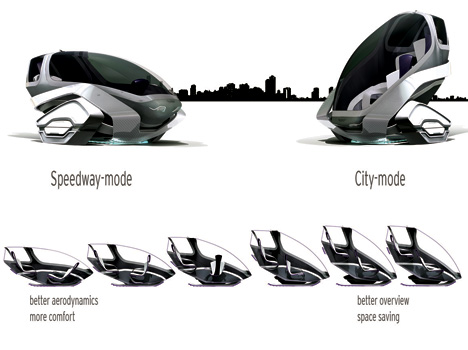
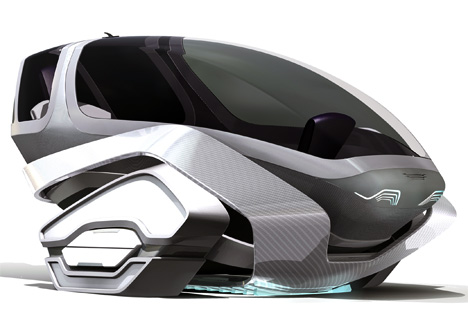
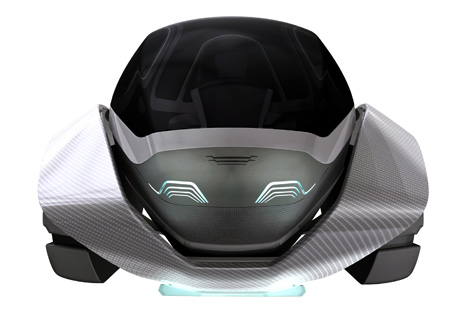
You wait till you�re legit enuf to drive and then you wish you didn�t have to! Truth is traffic snarls, parking woes, speedster and drunk drivers are out there to get you. So how about a future where cars no longer line the streets, they move magnetically, come in two modes and give you freedom from traffic jams. How about a future with the Speedway Concept Car? A future where we revolutionize the infrastructure facility by embedding the highways and streets with linear motors.
The idea is to enhance the current limited range and speed of the electric vehicles by putting in a linear motor into the highways. This external propulsion is embedded beneath the pavement and drives the vehicle by a drifting magnetic field. Due to the transfer of the propulsion power for long range drives into the infrastructure, the futuristic car can be lighter and nifty.
F�rg says that the �contact-free operating linear motor can be installed beneath existing roads and therefore offer the possibility to implement the new system step-by-step, without derailing the existing system. During the ride, the infrastructure can be used to charge the onboard batteries.�
Speedway�s interiors transcend between two different shapes and modes effortlessly. In the City-mode, the car becomes compact thus saving space and resolving parking issues. In this mode the seats of the car are upright and elevated to give a better overview.
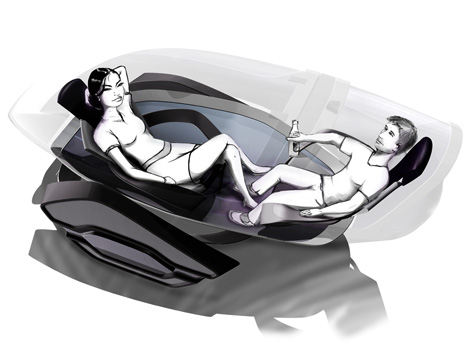
In the Speedway-mode, the aerodynamics of the car optimizes. The front seat turns around and switches to a more comfortable communicative position.
F�rg also proposes that we build parking towers where the cars can speed away to (automatically) once you disembark from it.
I know many of you are going to shake your head and go�here�s another one of those sci-fi-movies-inspired thang, but I tell you something like this is quite needed. I mean, have you seen the traffic jams at peak hours? Once passionate, now I dread driving me car!
For more information on this or other James Dyson Award entries click here.
You�ve got the need for the speed in the streets. You�ve got to go faster than your crappy metal-on-metal jalopy can take you. Faster, harder, stronger! Check out the Nissan-Motivity 400C concept by Tryi Yeh. The 400C has the Maglev engine system in each tire, making it quite floaty and speedy. The 400C has a wild, new triangle shape that reduces drag, while the driver seat controls retain their classic build (although, as you�ll see, you still might have a time getting used to the seat!)
A little more info on the Maglev concept:
The use of the physical properties of magnetic fields generated by superconducting magnets to cause an object (as a vehicle) to float above a solid surface.
This method has the potential to be faster, quieter and smoother than wheeled mass transit systems. The technology has the potential to exceed 4,000 mph (6,400 km/h) if deployed in an evacuated tunnel.
The above speed(s) are, of course, assuming you�re rocking a bullet train on the magnetic-levitation tracks. With a car using maglev wheels, the benefit is much, much less. But a benefit nonetheless. Rock them wheels!
The Bugatti Stratos is a slick design by France's Bruno Delussu, who was inspired by classic cars such as the Bugatti Type 57, Alfa Romeo 6C 2500 Mille Miglia and locomotive designs by Raymond Loewy. Delussu wasn't so interested in the technical aspects of those vehicles, however. He designed the Stratos to be a purely fantastical car that leans on its looks.
And lean on its looks it can. The end result, as you can see, is pretty impressive, affecting a retro air that's still undoubtedly futuristic. Check out more of the Bugatti Stratos in the gallery below.
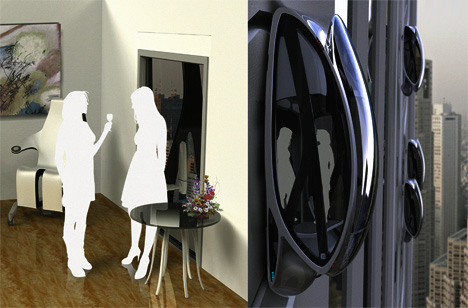
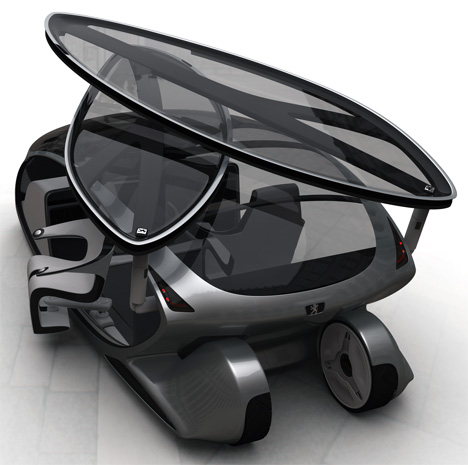
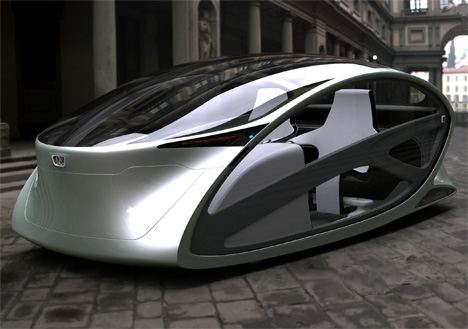
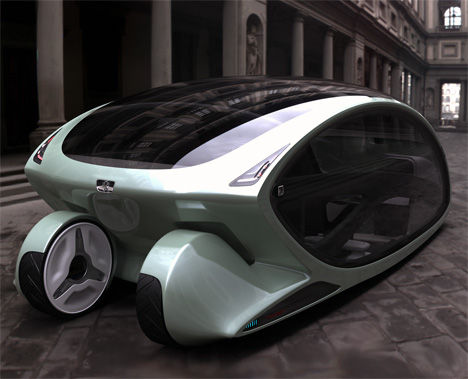
Picture this: you walk into this hub hanging outta your high-rise apartment and then it gently glides down to the ground level. Touch ground and it transforms into this ultimate car that looks and feels SEXY! This IS the Peugeot Metromorph and it transports you thru the city with ease. I dunno about your hometown, but where I live, I got to pay premium rent for parking my car in my apartment building. This kinda concept looks at eliminating parking woes. Hit the jump to see how this beauty soars.
There are some specific features that have been attributed to the Metromorph, to make it a viable concept:
Drivetrain- the vehicle is powered by two in wheel motors placed in the back. There are two battery cases on the back as well.
Interior- the seats are held by rotating arms which keep the seat level when the vehicle goes vertical or horizontal. When the vehicle is a balcony the seats are placed on a rolling base which enables them to become lounge chairs thus freeing up the interior of the car to make it a balcony. The interior is also left fairly hollow to accommodate the balcony mode.
Exterior- the car is designed to not look like a car vertically mounted to a building and still look like a vehicle when it�s on the road. So the wheels are concealed toward the inside. Rather than go vertically like many scissor doors today Metromorphs� arms rotate closely around the vehicle allowing the doors to freely open in a cramped area like a garage.
Well, hey, designer Jeongche Yoon even created a future for his futuristic car, the Quno:
In the future, the living environment will be alternated by modularized residences in order to save up labor cost and to reduce construction waste. Accordingly, there will be optimized vehicles which are [properly suited] to the future residence. The future mobility will deeply, inevitably harmonized with the living environment.
The way the Quno sits up on those future-homes is reminiscent of the wall-scaling pods in the film Minority Report. Will it ever come to pass? Probably not. We love us some visions of the future, though.
If Japan's number one telecommunications company NTT has its way, there could be a modular cellphone in your future, with various attachments that give the phone magical new powers. The star of the company's soothsaying is the flexible scroll attachment pictured here, giving you a big color screen to read the newspapers and magazines (and blogs) of 2015.
Take a look at this video, showing a couple of strange ideas NTT predicts we'll be writing about six years from now: