Showing posts with label Concepts. Show all posts

Wednesday, April 28, 2010

Tokyo Auto Salon - Lexus IS-F Circuit Club Sport Concepts Debuts

Here are a few snapshots of the Lexus IS F CCS (Circuit Club Sport) Concept car which was on display at the Tokyo auto salon this past weekend.
Dressed in a vibrant contrast of orange and black, the IS F CCS goes heavy on the carbon fiber. Or should we say "light". Much of the body has been rendered so, including the roof, rear wing and diffuser, front spoiler lip, the hood as well as the side mirrors. The interior also gets a do-over in carbon fiber, such as the center and lower consoles, gear stick, steering wheel trim and door panels. The IS F CCS is also fitted with two-tone bucket seats.

The weight reduction helps boost the performance of this 5.0 liter V8 enabled Lexus. That engines produces 423 hp in its Japanese market iteration. Additional performance enhancement comes by way of forged magnesium wheels wrapped in performance tires, carbon brake disks, sports suspension and a sport exhaust system with a titanium muffler.
But weight and track time figures Lexus has not yet provide. Nor, for that matter, is there any news on what Lexus plans, if anything, to do in the future with this concept.

Friday, August 7, 2009

Can You Capture a Laser In Your Hands?

via Gizmodo by Mark Wilson on 8/4/09

Short answer: Yes. Long answer: Yes, if you're demoing this remarkable laser/sound prototype that turns a laser pointer into...well...just watch the clip. It's really fun stuff.

Friday, July 31, 2009

Skylon spaceplane concept

via DVICE by Addy Dugdale on 7/30/09

Somewhat reminiscent of one of Professor Calculus's creations for cub reporter Tintin, the Skylon is what is known as a reusable launch vehicle for unpiloted space shenanigans. In short, it's a space plane. The creation of Reaction Engines Limited, a British outfit based at the Culham Science Center in Oxfordshire, the Skylon will be able to take off from and land at normal airport runways in order to deliver its payload of up to 13 tons in orbit.

All of this is down to Skylon's Sabre propulsion system, which is part jet engine, part rocket engine. The thrust is created by burning hydrogen and oxygen � a tricky concept, because air in the lower atmosphere can reach temperatures of 1000 degrees Centigrade. In order to cool the air before compressing and burning it, Reaction Engines have created a heat exchanger pre-cooler, which consists of ultra-fine piping that drops the temperature of the hot intake gases to minus 130 degrees Centigrade in just one hundredth of a second.

Whilst perhaps not yet as tangible as Richard Branson's White Knight Two, Skylon's technology is, you've got to admit, pretty amazing. And just look at the scale of the thing � it's immense! � in the gallery below. What does it remind you of?

*Cheaper than most space travel, that is.

Monday, July 27, 2009

Bike of the future will pay you back for all of that pedalling

via DVICE by Michael Trei on 7/26/09

This amazing bike concept is part exercise machine, part electric scooter, and will even help to pay your fare while providing a seat for the bus ride home. Designed by M�rten W�llgren, Il Choi, David Seesing, and Miika Hekkinen, it's the centerpiece of a car free concept for central London called London Garden, and winner of the Seymour Powell award in a contest called Future City Mobility.

The bike has solar panels inside the hubless wheels, which along with your pedaling power charge a battery that can drive the bike as an electric scooter. The really cool part, is that the designers also envision electric buses with docks for the folded bikes, that will tap your charged battery to help run the bus in exchange for bus fare.

The concept goes further, with tree like bus shelters where the bikes can be storedup in the air, and where the blowing breeze moving the stored bikes around will also generate electricity.

This all sounds a bit utopian, and doesn't really take into account people who aren't able to ride bikes, but 'm sure some parts of the design have real world potential.

Plywoodie: The Car

via Yanko Design by Chris Burns on 7/27/09

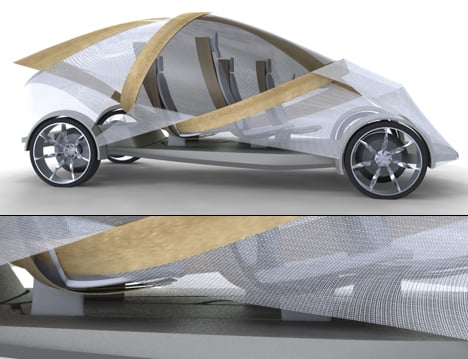
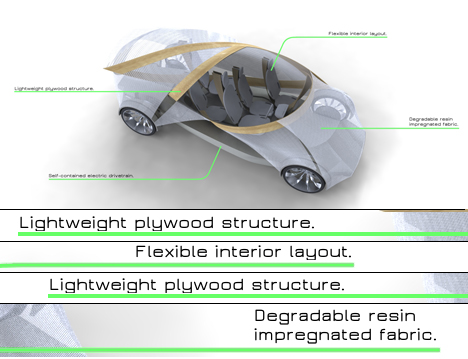
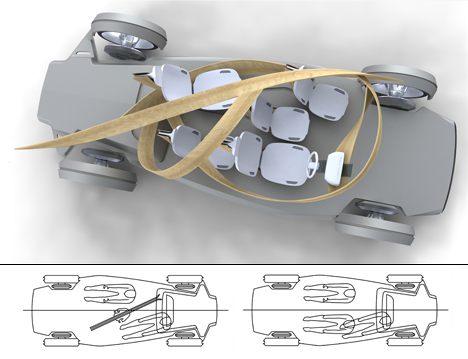
Jonathon Henshall�s got quite the upgrade for the woodie! Perhaps you�d like to first take a look at a Woodie Gallery. Ok so you�ve got an idea of what�s going on. Here�s the future. Light plywood structure with degradable impregnated fabric coverings. Also rubber wheels and a few metals on the bottom. Perhaps you�d also like to avoid hitting anything ever! In this future there�s no crashes!

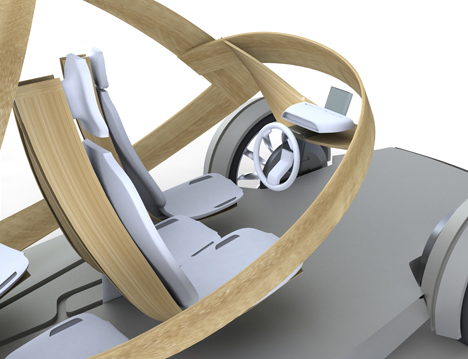
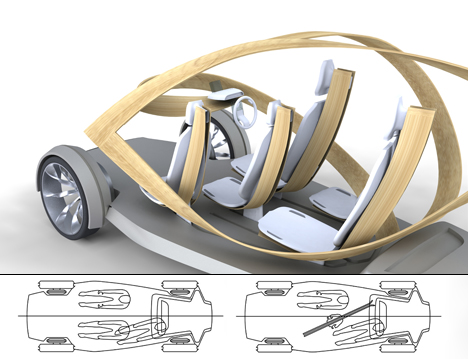
Once you�re inside take a look at the seats: combos on top of combos. Made for any number of different family members (perhaps for you expanding families?) Conceptuality ho! And of course, if you�re interested in these sorts of wild designs, take a peek through the entire Yanko Design automotive category.

Designer: Jonathon Henshall

Futuristic Plywood and Resin Vehicle by Jonathon Henshall 01

Futuristic Plywood and Resin Vehicle by Jonathon Henshall 02

Futuristic Plywood and Resin Vehicle by Jonathon Henshall 03

Futuristic Plywood and Resin Vehicle by Jonathon Henshall 04

Futuristic Plywood and Resin Vehicle by Jonathon Henshall 05

Sunday, July 26, 2009

Speed Away On Speedway

via Yanko Design by Radhika Seth on 7/24/09

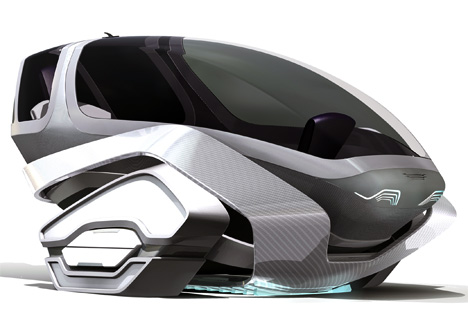
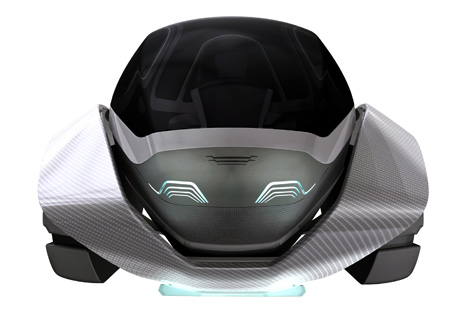
You wait till you�re legit enuf to drive and then you wish you didn�t have to! Truth is traffic snarls, parking woes, speedster and drunk drivers are out there to get you. So how about a future where cars no longer line the streets, they move magnetically, come in two modes and give you freedom from traffic jams. How about a future with the Speedway Concept Car? A future where we revolutionize the infrastructure facility by embedding the highways and streets with linear motors.

The idea is to enhance the current limited range and speed of the electric vehicles by putting in a linear motor into the highways. This external propulsion is embedded beneath the pavement and drives the vehicle by a drifting magnetic field. Due to the transfer of the propulsion power for long range drives into the infrastructure, the futuristic car can be lighter and nifty.

F�rg says that the �contact-free operating linear motor can be installed beneath existing roads and therefore offer the possibility to implement the new system step-by-step, without derailing the existing system. During the ride, the infrastructure can be used to charge the onboard batteries.�

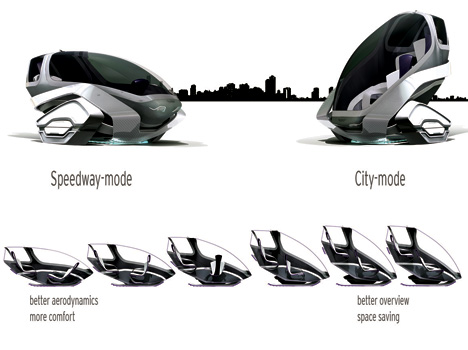
Speedway�s interiors transcend between two different shapes and modes effortlessly. In the City-mode, the car becomes compact thus saving space and resolving parking issues. In this mode the seats of the car are upright and elevated to give a better overview.

In the Speedway-mode, the aerodynamics of the car optimizes. The front seat turns around and switches to a more comfortable communicative position.

F�rg also proposes that we build parking towers where the cars can speed away to (automatically) once you disembark from it.

I know many of you are going to shake your head and go�here�s another one of those sci-fi-movies-inspired thang, but I tell you something like this is quite needed. I mean, have you seen the traffic jams at peak hours? Once passionate, now I dread driving me car!

For more information on this or other James Dyson Award entries click here.

Designer: Christian F�rg

speedway3

Speedway Concept Car by Christian Forg

speedway5

speedway6

Sunday, July 19, 2009

VW IPSE Concept

via DVICE by Kevin Hall on 7/17/09

Huh. Well, this looks like a bad idea. The "IPSE" is a car designed by Jeongche Yoon and Hoyoung Kihl that turns your average drive into an adventure.

Here's the scoop:

IPSE's virtual environment system recognizes outside surrounding then translates into virtual objects and living things. For example, in 'underwater' mode, other vehicles appear to the driver as sea creatures. While it drives through a street in the city, the driver doesn't see any buildings, cars and asphalt-paved road but beautiful trees and wild animals running on the charming grass land.
Driving is tricky enough as it is without a passenger screaming, "brake for that whale!" I mean, seriously, we already see people texting on their cells and watching movies while they're on the road. This is just asking for trouble.


Tuesday, July 14, 2009

Mercedes-Benz BlueZero Concept

via Car Body Design - News on 7/13/09
Mercedes Benz Concept BlueZero

Scheduled to debut at the 2009 Detroit Motor Show, the BlueZero is defined by Mercedes-Benz as a near-series vehicle.

In 2009, the first fuel-cell cars will be produced on a small scale, while the battery-electric drive models will be introduced in 2010.

The three BlueZERO variants are based on the unique sandwich-floor architecture which Mercedes-Benz introduced some ten years ago, initially for the A-Class and then for the B-Class, one of the aims being to integrate alternative drive systems.

This layout ensures a raised sitting position, a high level ofcrash safety for the passengers and excellent all-round visibility.

At the same time the powertrain technology is built into the sandwich floor, between the axles, so that the interior space is retained in full, and the centre of gravity is kept low.

Mercedes Benz Concept BlueZeroMercedes Benz Concept BlueZERO E CELLMercedes Benz Concept BlueZERO F CELL

Based on a single vehicle architecture, the modular concept allows three different drive configurations:

  • the BlueZERO E-CELL with battery-electric drive and a range of up to 200 kilometres using electric drive alone
  • the BlueZERO F-CELL (fuel cell) with a range of well over 400 kilometres using electric drive
  • the BlueZERO E-CELL PLUS with electric drive and additional internal combustion engine as power generator (range extender).
Mercedes Benz BlueZero Concept LayoutMercedes Benz BlueZero Concept RangeMercedes Benz Concept BlueZero E CELLMercedes Benz Concept BlueZero F CELLMercedes Benz Concept BlueZero E CELL Plus
This last version has an overall range of up to 600 kilometres and can cover a distance of up to 100 kilometres using electric drive alone.

All three BlueZERO variants share the same key technical components, while the design and vehicle dimensions are identical.

Advantages of the modified construction include the positive effect of the major drive components on the centre of gravity, their space-saving design and the fact that they are extremely well protected within the vehicle underbody.

Mercedes Benz BlueZero Concept EngineMercedes Benz BlueZero Concept Interior

Technical Features

All three BlueZERO models feature front-wheel drive, which is typical for this class of car. The Mercedes engineers have put together a modular system comprising several flexibly combinable drive components.

These include liquid-cooled lithium-ion batteries with a storage capacity of up to 35 kWh and the compact electric motor with a maximum output of 100 kW (continuous output 70 kW), which develops a peak torque of 320 Nm.

All three variants accelerate from 0 to 100 km/h in less than 11 seconds. Their top speed is electronically limited to 150 km/h in the interests of optimal range and energy efficiency.

With a charging capacity of 15 kW, the powerful lithium-ion batteries in the BlueZERO E-CELL and the BlueZERO E-CELL PLUS can store enough energy for a range of 50 kilometres within 30 minutes.

In terms of purely electrical drive, one or two hours of charging time is needed for a range of 100 and 200 kilometres respectively. The charging times are doubled if the charging capacity is 7 kW, as would be the case in a normal household. Both of these BlueZERO vehicles incorporate an electronic control unit that supports intelligent charging stations and billing systems.

At the rear, the BlueZERO E-CELL PLUS has the same 1.0-litre turbocharged petrol engine as the smart fortwo as an additional range extender.

This compact three-cylinder powerplant has an output of 50 kW at a constant 3500 rpm. If required, it can recharge the 17.5-kWh lithium-ion battery by means of a similarly rated alternator.

A range of up to 600 kilometres is possible on a single tank. The purely electrical, locally emission-free range is up to 100 kilometres. The BlueZERO F-CELL with fuel-cell drive achieves a range of well over 400 kilometres with zero emissions (as per NEDC).

Sunday, July 12, 2009

Peugeot Epine Concept

via Car Body Design - News on 7/10/09
Peugeot Epine Concept

The brief of the project was to create an eco-friendly hybrid vehicle that could offer its occupants a racing track experience while at the same time providing a new way of being in contact with nature.

Peugeot Epine Rendering

The minimalistic design takes inspiration from racing vehicles - motorcycles and Formula One cars - and nature elements - in this case a whale skeleton.

Peugeot Epine

The main technical feature is the Epine (spine) system, which allows for a full motion of seating arrangements thanks to the adoption of drive-by-wire technology for the steering system.

Peugeot Epine

The powerplant is located at the rear while the storage compartment is in the front. The suspension system adopts the Michelin Tweel concept (airless wheels) and is housed inside the wheel itself. The materials and layout of allow for the wheel spokes to compress and uncompress offering for a wide range of motion.

Peugeot Epine

The main dimensions are a total length of 4,260 mm, a width of 1,882 mm and a height of 1,153 mm.

About the Designer

Daniel Schumpert graduated from the College for Creative Studies (CCS) in Detroit MI with a BFA in Transportation Design.

Contact details:


Fornasari Racing Buggy

Fornasari Racing Buggy Rendering

The Fornasary Racing Buggy is an extreme 2+2 SUV which combines design elements typical of concept cars with a versatile exterior : the removable roof, doors and boots can turn the car into a buggy-like "leisure" vehicle for summer time.

The official debut is scheduled for the next Frankfurt Motor Show in September. The base price will start at 80,000 Euros.

Fornasari Racing Buggy Rendering

The original idea was to create new trends in the premium off-road market segments, by presenting something different, an extreme concept car ready for production.

This was made possible by Fornasari's position: being a small automaker, as Fornasari's Designer Shuai Feng explains: "we have the possibilities to do something that big automakers can not do."

The Racing Buggy was designed as a racing-inspired leisure vehicle: "in winter time, we keep it close to go to ski with our friends, then in summer time, we take off the roof, the doors, the boots, and go to the beach."

The exterior is offered with two-tone paintwork as a standard, with the main body in matt finish. Customers can choose among different materials for the exterior trims - alumium, carbon fiber and titanium.

The main dimensions a re a length 435 cm, a width of 200 cmand a height of 172 cm, with a wheelbase of 275 cm and a total weight of 1600 kg.

Fornasari Racing Buggy Rendering

The structure is a custom built molybdenum-chrome tubular chassis which comprises more than 40 tubes and has a total weight under 150 kg. The suspension system adopts a double wishbone layout with welded joints, inspired from the Formula One cars.

Fornasari Racing Buggy Rendering

The engine is a GM-derived 7.0 liter V8 unit which delivers 610 hp at 6,1000 rpm and 748 Nm at 5,100 rpm.

It can be coupled to either a manual or an automatic transmission, both with six speeds.

The all-wheel drive system adopts a Viscous Coupling center differential (60% rear, 40% front) and a Rear Dana44 Axle Assembly with Limited Slip at the rear.

The Racing Buggy can accelerate from 0 to 100 km/h in just 3.8 seconds, and from 0 to 1,000 m in 23 seconds. The top speed is limited to 280 km/h.

Fornasari Racing Buggy Rendering

The projected price for the base model will be approximately 80,000 Euros. For more information visit www.fornasaricars.com.

Wednesday, July 8, 2009

Project Nomad's Robotic Animal Vehicles

via Gizmodo by Adam Frucci on 7/6/09
Mechanical horse finds its own fuel

As far as concepts go, Jason Battersby's Project Nomad is pretty out there. It's a series of rideable robo-vehicles that look like animals, getting their energy from plants. Yeah, let us know when these become feasible, Jason.

project-nomad_zfjcb_5965

project-nomad_xorqe_5965

project-nomad_k7hcj_5965

project-nomad_knlmu_5965

Friday, July 3, 2009

AUDI EXO

via Yanko Design by Anthony James on 7/1/09

audi_exo_03

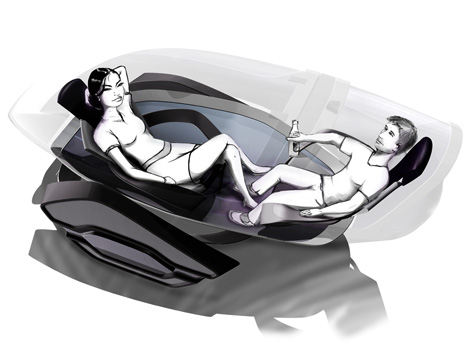
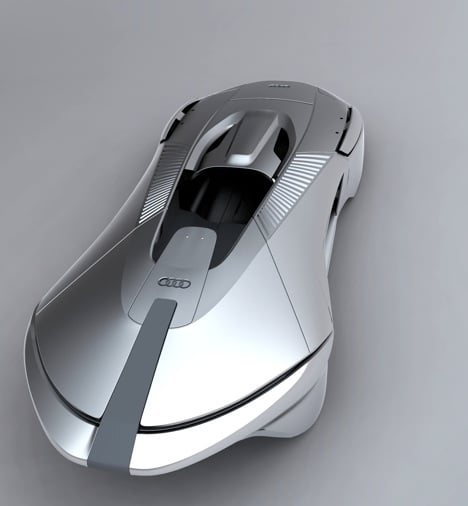
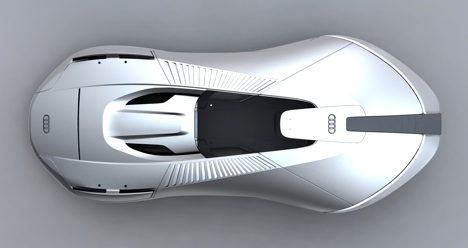
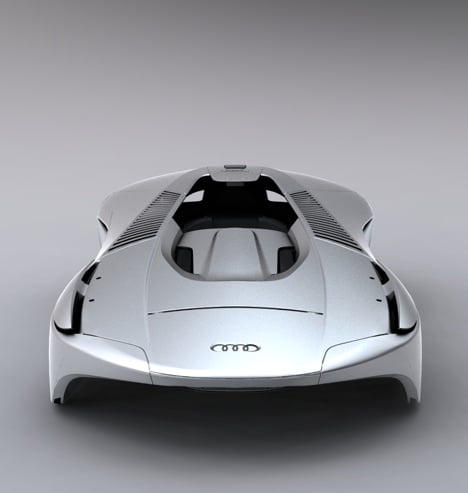
When I first learned to ride a horse, I was told that I needed to move with the horse, as if of one mind. I was bucked off twice before I finally let go and learned to let go and move with �Davis� the horse, as opposed to trying to force her to bend to my will. That lesson seems to be apparent in Designer Andrea Mocellin�s latest �EXO- AUDI� concept. Andrea feels that the best way to drive is to be at one with your machine.

By �Taking advantage of the exoskeleton and nanotechnology evolution, we can create a potential energy source and produce a new generation of human powered vehicles: faster and stronger.� Inspired by sports equipment, footwear design and human instinct, this design uses the owners own kinetic energy to power your way down the street. Though it is not quite clear if Andrea is talking about pedal power or full body motion, this design not only re-imagines power train options but also makes us look deeper into the obvious inefficiency of modern human conveyance systems. No wonder GM is having a hard time finding a buyer for HUMMER.

Designer: Andrea Mocellin

audi_exo_01

audi_exo_02

audi_exo_08

Super Sport Car Evolution